Welcome to the CRM Playbook.
This document explains why CRM is important and how it is used in the Everfield ecosystem.
The Playbook helps companies build a clear and consistent CRM process. It also supports learning across the whole Everfield group.
Purpose of the CRM Playbook
The main goal of this Playbook is to help you create a consistent CRM process.
A good CRM process allows you to:
-
work with the same data structure across teams,
-
use data to make better business decisions,
-
learn from other companies in the Everfield group,
-
scale your sales and customer processes.
The Playbook is based on real CRM implementations and proven best practices.
Who Is This Playbook For
This Playbook is created for:
-
companies in the Everfield group,
-
implementation partners,
-
Everfield HQ teams.
It is useful for both new and existing CRM users.
What You Will Learn
By using this Playbook, you will learn:
-
how to set up a CRM process step by step,
-
what system requirements are needed,
-
how to design a clear data structure,
-
how to align CRM with sales and customer processes,
-
best practices from other Everfield companies.
You will also find:
-
lessons learned from previous CRM implementations,
-
common mistakes and how to avoid them,
-
example costs,
-
screenshots and practical examples.
Why CRM Is Important in Everfield
CRM helps Everfield companies work in a more structured way. It makes cooperation easier and improves visibility across the group.
With a shared CRM approach, companies can:
-
improve data quality,
-
compare performance,
-
share knowledge,
-
grow faster and more efficiently.
Summary
The CRM Playbook is a practical guide for building and improving CRM in the Everfield ecosystem. It focuses on consistency, learning, and best practices.
Use this Playbook as a reference when:
-
setting up a new CRM,
-
improving an existing CRM,
-
aligning your processes with Everfield standards.
Executive Summary
Purpose
Everfield requires all portfolio companies to use a CRM system. The goal is to create a consistent and data-driven way of working across the group.
CRM is not only a reporting tool. It is a core system for Sales and Marketing operations.
Everfield supports HubSpot as the preferred group CRM.
-
As of January 2026, 70% of companies use HubSpot
-
Everfield will remove manual sales and marketing reports for companies working in HubSpot
Why Everfield Requires a CRM
Everfield requires a CRM to:
-
enable group-wide comparability of pipeline, bookings, and performance metrics
-
support performance management at company and group level
-
enable repeatable go-to-market (GTM) execution across businesses
-
increase revenue predictability through structured pipeline management
What You Will Get
By following this Playbook, you will get:
-
a step-by-step implementation journey, from kickoff to stabilisation
-
clear understanding of roles needed in lean teams
-
clarity on what Everfield provides and what is supported by the implementation partner
-
a clear difference between mandatory Everfield requirements and optional improvements
-
a decision path based on your company’s CRM maturity
What Success Looks Like
Success means:
-
a live HubSpot CRM with agreed definitions, required fields, core pipelines, and basic reporting
-
a named internal CRM Owner
-
a clear operating rhythm:
-
weekly pipeline hygiene
-
regular performance and KPI reviews
-
-
Sales and Marketing reporting moved from manual spreadsheets to automated, API-based reporting
Why Everfield Chose HubSpot
Fit for the Everfield Portfolio
Everfield companies usually have:
-
small Sales and Marketing teams (often fewer than 10 people)
-
limited operations capacity
-
a need for fast implementation and high user adoption
The CRM must be simple to use and quick to launch.
What HubSpot Offers
HubSpot provides:
-
Speed to value
Fast setup and an intuitive user interface -
High adoption
Low training effort for non-technical users -
Modular scalability
Start with Sales CRM and later add Marketing, Service, or Operations when needed
What HubSpot Enables at Group Level
Across the Everfield group, HubSpot enables:
-
a shared pipeline and bookings language across companies
-
standardised data extraction for group-level reporting
-
consistent baseline KPIs, with flexibility beyond the minimum requirements
This supports better comparison and performance tracking across the group.
What HubSpot Is Not
HubSpot is:
-
not a replacement for good sales process design
-
not a “set and forget” system
A CRM creates value only when:
-
sales and marketing processes are clearly defined
-
data discipline is followed by all users
-
clear ownership and a regular operating rhythm are in place
Who This Playbook Is For (and How to Use It)
This Playbook is used by different stakeholders.
Everyone works with the same source of truth.
Portfolio Company Leadership Teams
This Playbook helps leadership teams to:
-
understand what Everfield requires
-
know how to move from the current state to a compliant CRM
-
use CRM to manage performance and revenue predictability
Implementation Partner
For implementation partners, this Playbook is:
-
a reference for configuration and delivery
-
a clear guide to Everfield’s non-negotiable requirements
-
a source of acceptance criteria for successful delivery
Group Directors and Business Partners
For group-level roles, this Playbook helps to:
-
communicate expectations in a consistent way
-
support companies during change and adoption
-
validate CRM compliance at key implementation stages
Maturity Track
This section is not extra content.
It is a routing mechanism that helps teams choose the right path and avoid wasting time or overbuilding.
Track A – No CRM Today
Starting point:
-
spreadsheets, inboxes, ad-hoc reports
Main risks:
-
inconsistent data entry
-
weak lead and deal qualification
-
limited visibility of performance
Track B – CRM Exists, Being Replaced
Starting point:
-
tools like Pipedrive, Salesforce, or similar
Main risks:
-
poor data quality
-
too much customisation
-
old or unclear pipeline stage definitions
Track C – HubSpot Exists, Needs to Become Everfield-Compliant
Starting point:
-
HubSpot already in use
Main risks:
-
misaligned definitions
-
missing required fields
-
inconsistent pipelines
Why Define a Track If the Playbook Is One?
Everfield requirements are the same for all companies. However:
-
the work plan is different
-
the risk level is different
-
the partner effort is different
The maturity track defines:
-
how much time is needed
-
how deep the implementation must go
This helps companies run a focused and efficient CRM project.
2. Everfield CRM Configuration Requirements
This section defines the mandatory rules for CRM setup.
A CRM is considered Everfield-compliant only if these requirements are met.
The requirements cover:
-
data and definitions
-
pipelines and probabilities
-
reporting
-
integrations
Compliance Overview
Non-Negotiable Requirements
All companies must meet the following rules:
-
Everfield definitions are used consistently
-
all minimum required data fields are completed
-
pipeline stages and probabilities follow agreed rules
-
CRM data can be exported reliably to Everfield systems
-
CRM supports reporting on:
-
Prospects
-
Leads
-
Qualified Leads
-
Opportunities (Deals)
-
Bookings
-
Customers
-
These elements are required for group-level reporting and comparison.
Optional Enhancements
Companies may also add:
-
extra automation
-
additional reports
-
additional system integrations
-
a qualification framework required to open a sales opportunity
These enhancements are optional and do not affect compliance status.
Compliance Assessment
Compliance is checked:
-
after CRM go-live
-
again when Everfield connects to the CRM via API
The goal is to ensure stable data quality over time.
Data Export and Integration Requirements
To support group reporting:
-
CRM data must be exportable to Everfield systems
-
API-based integration is available between HubSpot and Everfield’s data lake
-
HubSpot-to-Everfield integration is preferred and prioritised
Definitions (Everfield Language)
Everfield does not require one specific lead qualification framework. Companies can choose the method that best fits their business (for example: BANT, SPIN, MEDDICC).
Everfield can support with advice and best practices when needed.
Each company must:
-
define its own qualification approach,
-
apply it consistently,
-
make sure all leads are properly qualified.
For group reporting, Everfield tracks only two categories:
-
Leads
-
Qualified Leads
A Qualified Lead may include several internal stages (for example MQL and SQL combined into one “Qualified Lead” category).
Core CRM Definitions
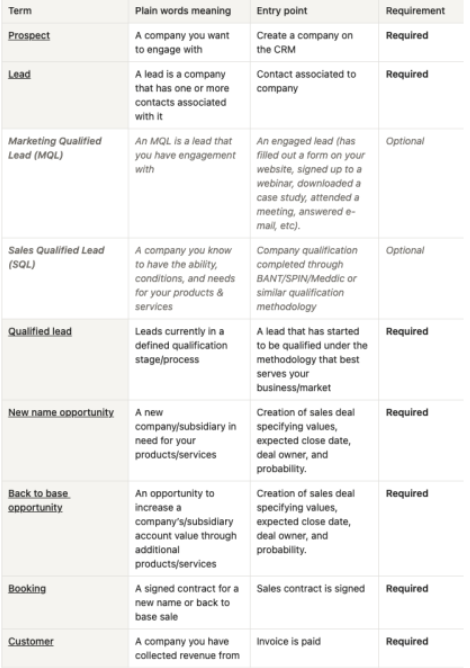
Key Notes
-
MQL and SQL are optional internal stages
-
For Everfield reporting, both are grouped under Qualified Leads
-
What matters most is clear definitions and consistent usage